Part 1: Air Quaility
OK so I know you have read click bait articles that tell you all sorts of “facts” about flying but I’m here to tell you that most of them are actually false and not the least bit factual. It’s confusing, I know. A person who claims to be an expert or who has talked to a flight attendant at some airline gives you all sorts of shocking facts about all things aviation.
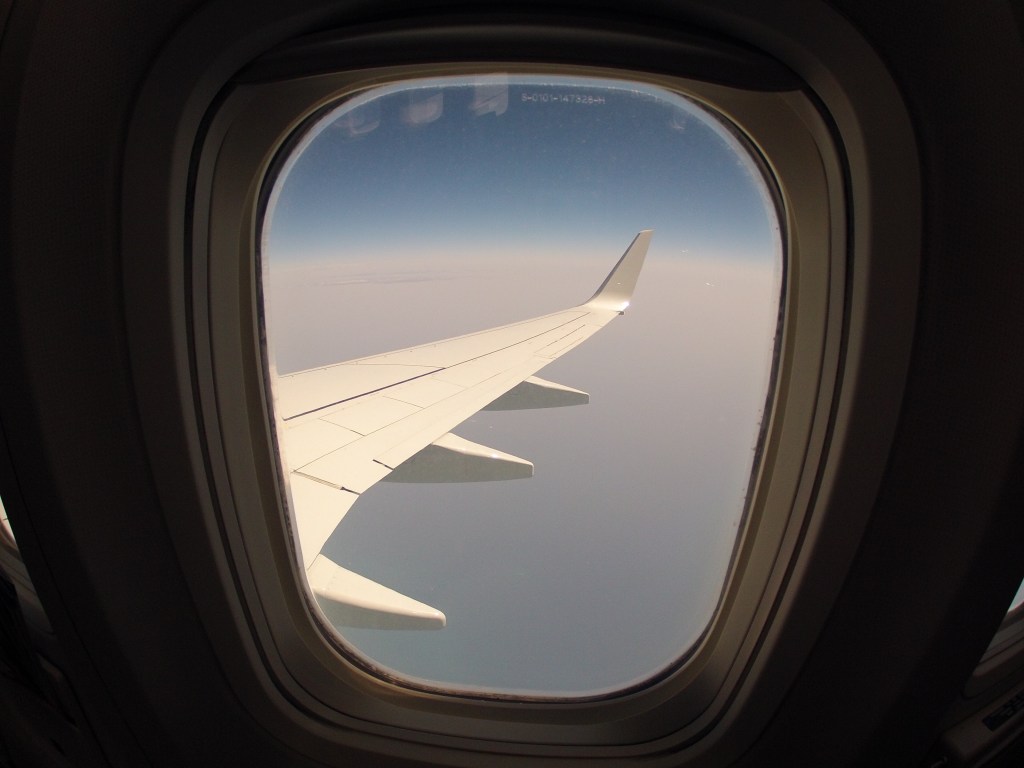
The claim is: Flying on an airplane will get me sick.
One of the main misperceptions is how horrible the air quality in the cabin is. In fact it really isn’t that bad and might even be the highest quality air you’ve ever breathed.
Airplanes have pretty interesting air conditioning systems. Typically the way it works is that outside air is brought into the airplane from the engine, and no, it’s not filled with exhaust. Some of the air is cooled using an air cycle machine (fancy aviation way of saying air conditioner) and some is left hot. A valve balances the temperatures of the cold and hot air into a mixing chamber and is then pumped into the cabin of the airplane.
Now here is where the myth comes in. Up on the flight deck (where the pilots are) there is a recirculation switch that typically stays on. This switch does not recirculate ALL the air in the cabin, but does circulate a percentage of the air. The air in the cabin (where the passengers sit) however, gets completely cycled out every few minutes. This depends a bit on the aircraft type but is generally between 2–4 minutes. The switch can be turned off to replace all the air constantly. So why don’t we fly with it off? It’s actually really helpful to increase fuel efficiency of the airplane…the recirculation fans reduce the amount of effort needed to refill the airplane constantly.
Here is what is interesting though…positive pressure. Airplanes must be pressurized to fly at the altitudes typical flown. At 35,000 feet, there isn’t enough air to survive for more than a few minutes, so the airplane has to be crammed with air constantly. As an aside, airplanes leak a bit. It’s sort of like taking a Mylar balloon and poking a tiny hole in it. If you don’t keep adding air the ballon will eventually deflate and the pressure will equalize between the inside of the ballon and the outside. At 35,000 feet, commercial airplanes are pressurized to about 7.8 psid (pounds per square inch differential). It’s a measure of the pressure difference between the airplane and the outside air. Psid when you are sitting at the airport with the door open is zero. When the airplane door is shut the pressure goes up a bit- positive pressure.
Part of the reason that the psid goes up is that it helps keep the aircraft tube rigid to give it more strength for the parts of the flight when pressurization are not necessary. Here’s an experiment you can do at home to demonstrate why pressurization is beneficial to aircraft strength: Grab a can of soda and stand on it without opening it. It will likely hold your weight pretty well even if you dent it a bit. Now open the can up and stand on it. It might support your weight if you haven’t dented the side of the can. If you are standing on it opened have a friend flick it with a finger quickly and the can will collapse. A pressurized container can add strength!
Now back to breathing. If we didn’t pressurize the airplane you wouldn’t be able to breath. Mount Everest is 29,029 feet tall and most climbers must use oxygen to climb it and survive. Without oxygen the time of useful consciousness at 35,000 feet is around 30–60 seconds depending on the person.
Another side note: this is why the safety videos that nobody watches talks about donning your mask first when it drops down and then assisting others. You may not have time to get your mask on much less another person’s first. I know the parenting instincts might make you want to put a mask on your kiddo first, but don’t.
So now, when you are flying at 35,000 feet, the pressurization is cramming air into the airplane, a small amount leaks out just because airplanes aren’t perfect sealed tubes.
Sorry, another side note: the leaks can be so big that when I flew in the military on cargo airplanes, crew members would sometimes smoke near the back at the cargo ramp on the airplane. It would push the smoke out of the airplane and us pilots up front would be none the wiser.
OK, so lots of pressure getting pumped in, small leaks letting some out and in addition, actual valves that let tons of air out! These are called outflow values and regulate to allow the tube to be pressurized to the appropriate amount. Too much pressurization is just as bad as not enough.
All of this adds up to air that is actually cleaner than the air in your house and the air in a hospital! This is really important information when you consider the probability of getting sick on an airplane.
Back in 2009, then Vice President Biden was getting interviewed on various early morning talk shows discussing the pandemic of the day (no, not COVID-19 but H1N1). He mentioned it was much safer to ride a train. He was wrong but this myth seems to have been perpetuated to our current pandemic here in 2020. The CDC quickly refuted that claim stating that riding a train is actually less safe than flying on an airplane.
There is quite a bit of research about the possibility of getting sick on airplanes and the data just doesn’t support a higher chance. In 2009, a study by the University of Illinois School of Public Health determined that you have between a 1 in 10,000 to a 1 in a million chance of contracting tuberculosis in flight. That’s pretty low! Do people get sick from other passengers? I’m sure that there are plenty of cases, but I’d guess it’s not happening on the airplane but is happening on the parking lot shuttle, standing at the ticket counters, or security, or the jetway.
Most research is showing that wearing a mask will prevent the spread of sickness. This is gross, but think about it like a face diaper. It keeps your filthy snot and spit, which is what viruses apparently hitch hike on, from getting too far from your face. Yes, some of it may leak out but hopefully the speed is so slow that it can’t get too far.
Did I mention that the air travels from vents above your head to ducts that suck it out near your feet? That’s good news for keeping your germs away from others as well. Add in the all important HEPA (high-efficiency particulate air) filters and you have a pretty good chance that your virus won’t get transmitted to others.
Let’s do an exercise I used to do when I was an instructor pilot in the Air Force. I call it the Journey of Alvin the Air Molecule. Stay with me on a fantastic journey!
Alvin is just hanging with his buddies at 35,000 feet when all of a sudden, a CFM-56 jet engine on a 737–800 scoops him up and he goes through the compression section of the jet engine and siphoned off at the 5th stage valve (typically) and pushed into the pressurization system. Alvin goes through the hot tube that carries him and billions of his buddies to the mixing chamber where his other buddies are freezing cold the result is a nice 70 degree temperature Alvin. From there Alvin gets pushed out of the the air vent over your head.
You happen to be wearing a mask that was handcrafted with love from your grandma in a beautiful Hawaiian print, when all of a sudden you take a breath (as we are prone to do as humans) and Alvin gets sucked up your nose and some filthy virus decides its time to go for a ride on the little droplet of water that Alvin is near. Now because you are wearing a mask, the water droplet (lets call this guy Carl the Corona Virus) next to our buddy Alvin will go one of two directions. Either he gets trapped in the Hawaiian print mask because lets be honest…masks get full of moisture and humidity which is why they are so fun to wear (sarcasm), OR it gets through the rather wide mesh cloth.
If Carl gets trapped in the mask his journey is pretty much over. If he makes a break for it he’s gotta get as far away from your mask as possible to get that crying toddler sick that is near you (you don’t want him to get sick but Carl does… Carl is not cool). All of a sudden that gasper vent above you smashes Carl and Alvin down to the ground. Meanwhile, Carl is cursing the gasper and Alvins buddies.
Carl and Alvin get pumped through a bunch of vents to a HEPA filter. Another trap for Carl. In fact 99.97% of Carl’s buddies wont make it past the filter, but if they do they have a pretty close to a 1 in 4 chance of not even getting back into the airplane. That means that of the 0.03% that made it past the filter, now only 0.0075% of Carl’s buddies that escaped the mask are going to make it back into the airplane!
Typically that 0.0075% of Carl’s buddies have only a few more chances to get to that toddler and even then, Carl might die sometime between his escape from your mask and the point when he gets taken in by the toddler. It’s hot and cold and dry depending on where Carl ends up and as humidity and temperature get out of acceptable ranges, viruses are no longer viable. Meanwhile, Alvin is just hanging out cycling through the HEPA filter and in and out of your lungs until he gets dropped off at 35,000 feet again a few hundred miles from where he started!
The caveat exemplar is this: I’m not a doctor. I’m a pilot. So while I think I know everything, I actually don’t. What I do know and understand is the way airplanes work and based on that mechanical understanding, I’d rather spend a lifetime on an airplane than in a hospital. Luckily, it appears that the more time you spend on an airplane the less likely you are to get a virus that will put you in a hospital!
https://www.npr.org/sections/health-shots/2009/04/biden_says_he_wouldnt_fly_righ.html
Click to access AC_61-107B_CHG_1.pdf
https://news.delta.com/harvard-study-enhanced-cleaning-onboard-airplanes-helps-reduce-infection-risk
https://onlinelibrary.wiley.com/doi/abs/10.1111/j.1539-6924.2008.01161.x
 Airliftpilot Travelogue